


Imagine your security cameras doing more than recording: they begin to understand what they see. That is the core of computer vision—turning passive video into decision-ready data, moving from simple surveillance to active, intelligent supervision.
Computer vision as an operational lever—not just a concept
Computer vision lets systems analyse and interpret the visual world. For industrial decision-makers, that means turning an existing camera estate into reliable, auditable information.
Instead of teams scrubbing hours of footage, AI works in real time and answers operational questions. How do you ensure every operator in an ATEX zone wears a helmet? How do you spot intrusions at night without overwhelming a guard with dozens of screens?
Faster adoption—with room to grow
AI adoption in France is rising, but major potential remains. In 2024, only 10% of French companies (10+ employees) had adopted at least one AI technology—a notable increase from 2023.
That still trails the EU average of 13%, highlighting headroom for mature technologies like computer vision. For more detail, see the latest INSEE statistics on AI adoption.
Leading companies—often supported by experts like ARCY—are already building durable advantage with detection and analytics pipelines designed to scale and meet GDPR expectations.
Computer vision does not replace teams; it augments them. It acts as a smart filter that prioritises alerts, reduces cognitive load, and lets operators focus on decisions.
From concept to concrete industrial use cases
Computer vision shines when tied to specific scenarios with clear success metrics. Examples on industrial sites include:
- Perimeter security: Detecting people or vehicles crossing sensitive zones on a schedule—so only meaningful alerts fire.
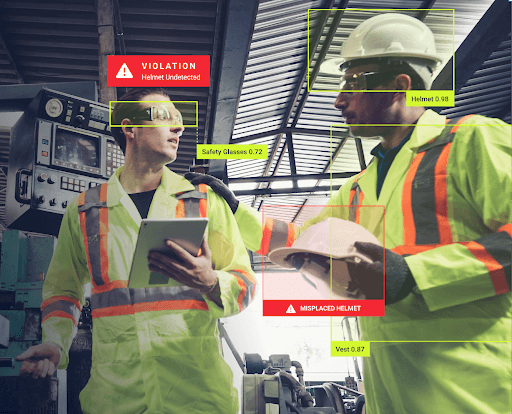
- Health & safety compliance: Checking PPE in real time—helmets, vests, masks—where rules require it.
- Quality inspection: Spotting defects on a line, anomalies on finished goods, or packaging compliance.
This article outlines how to assess computer vision for your organisation—from deployment steps to operational performance.
Strengthening industrial security with practical applications
On industrial or logistics sites, computer vision delivers value quickly by leveraging existing cameras. Skip the theory: consider securing sensitive areas against unauthorised access, perimeter breaches, or missing PPE.
Picture a system that detects a perimeter breach at night on its own. It does not wait for a tired operator to notice it on a video wall—it sends a targeted alert with video evidence for immediate action and an auditable log.
The flow is simple: a camera captures, AI analyses, and the system outputs actionable data.
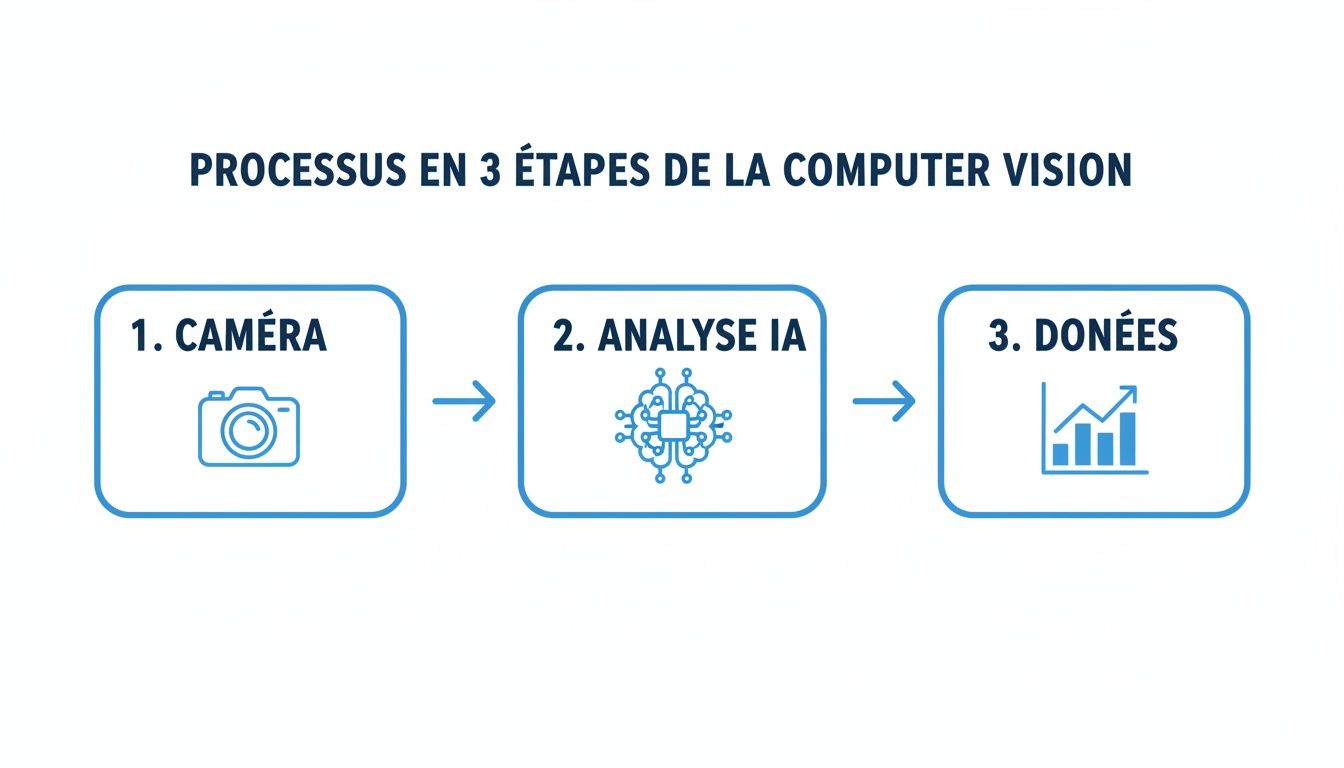
That turns any standard camera into a smart sensor, feeding dashboards and real-time alerting.
PPE detection and zone security
A high-impact use case is verifying personal protective equipment (PPE). An algorithm can confirm that a technician entering a risk area wears the required helmet, glasses, or high-vis vest. On a gap, an alert is raised immediately—often before an incident occurs.
Our methodology is pragmatic:
- Use what you already have. We connect to standard video streams—no need to replace the entire fleet.
- Define business rules together. Zones, schedules, and thresholds tuned to reduce noise.
- Track performance. Operational KPIs matter: detection rate, false positives, time to resolve uncertainty, time saved—bound to camera quality, lighting, and viewing angles.
Assistance-first design and compliance
We default to face anonymisation for GDPR-aligned deployments. The goal is event and behaviour detection—not individual surveillance—and that builds trust with teams.
AI should filter noise and surface what matters. Smart systems do not only alert; they document—with visual evidence that speeds resolution and post-incident review.
These systems are not “100% automatic” or “zero error.” They do help security teams focus on intervention instead of passive screen-watching.
Automating detection frees time and makes site safety more effective—see our industrial safety page for deployment examples.
Deploying an AI project: from PoC to production
AI programmes can feel complex, but a clear roadmap turns experiments into robust, auditable, cost-aware solutions. Structured delivery is how you control risk and prove ROI. Here is a three-step path to production.
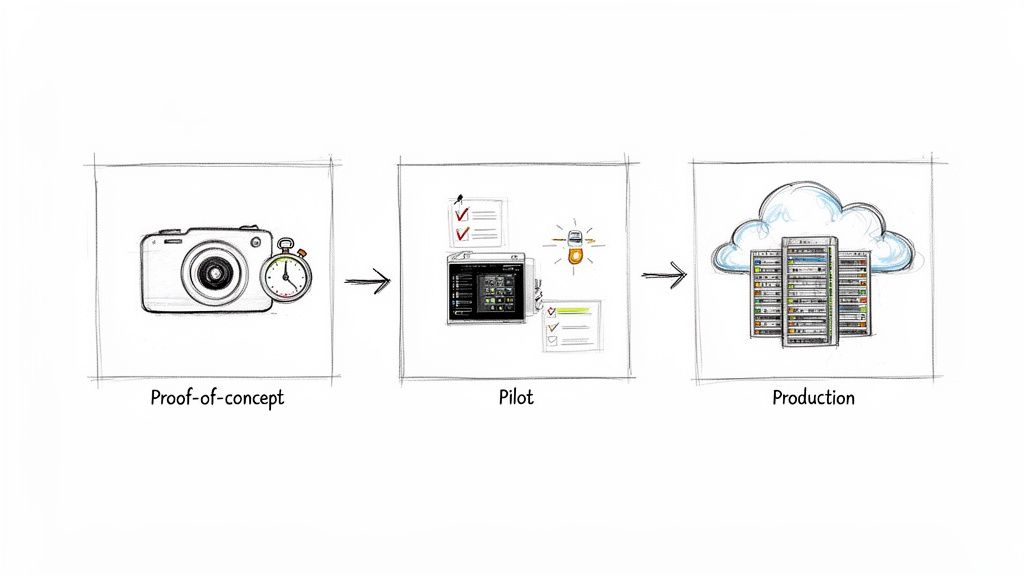
This pragmatic view keeps the project aligned with business goals while teams adopt it progressively.
Phase 1: Operational scoping (1 week)
The foundation: translate a business need into a tight technical and functional scope.
- Scenarios to detect: Line crossings, missing PPE, part defects, etc.
- Zones and schedules: Where and when the system runs to avoid noise.
- Success KPIs: Detection rate, false positives, time to resolve events.
- Go/no-go criteria: Minimum performance and IT/GDPR gates before a pilot.
Shared expectations across stakeholders reduce surprises later.
Phase 2: Instrumented field pilot (2–4 weeks)
The reality check: measure performance in your environment.
We connect computer vision to your existing camera feeds and tune models for lighting, angles, and variability—anonymisation included when required.
A pilot is about measurement, not perfection: quantify KPIs and daily alert load to validate value objectively.
Phase 3: Production rollout (2–6 weeks)
On success, industrialise: monitoring, model versioning, clear SLAs, API and webhook integrations for workflows, escalation playbooks, security/GDPR sign-off, and a plan to scale to more sites.
Overcoming technical and human obstacles
Deploying computer vision goes beyond models. Anticipating technical, human, and regulatory friction separates experiments from lasting operations.
Technical challenges in the field
Real-world variability—lighting, angles, occlusion, video quality—breaks lab-perfect demos.
- Tight use-case scoping.
- Rigorous testing across conditions.
- Fine-tuned zones and adaptive thresholds.
- Continuous monitoring with short iteration cycles.
Human and operational resistance
Fear of “surveillance” and alert fatigue are common.
We design AI as an assistant, not a watcher—assistance-oriented UX, anonymisation by default, collective safety rather than individual control.
Smart rules, prioritisation, and integration with ticketing or reporting keep alerts actionable.
Regulatory and data stewardship
GDPR and personal data demand rigour for video workloads.
Our approach rests on three pillars—select a tab for more detail:
Only the video data that matters
The computer vision pipeline limits collection, extraction, and retention to the streams, metadata, and evidence strictly required for the operational scenario and downstream decisions.
Clear documentation (DPA, retention, registers) completes the picture.
Choosing the right deployment architecture
Effectiveness is not only about algorithms. Architecture trades off latency, cost, security, and compliance.
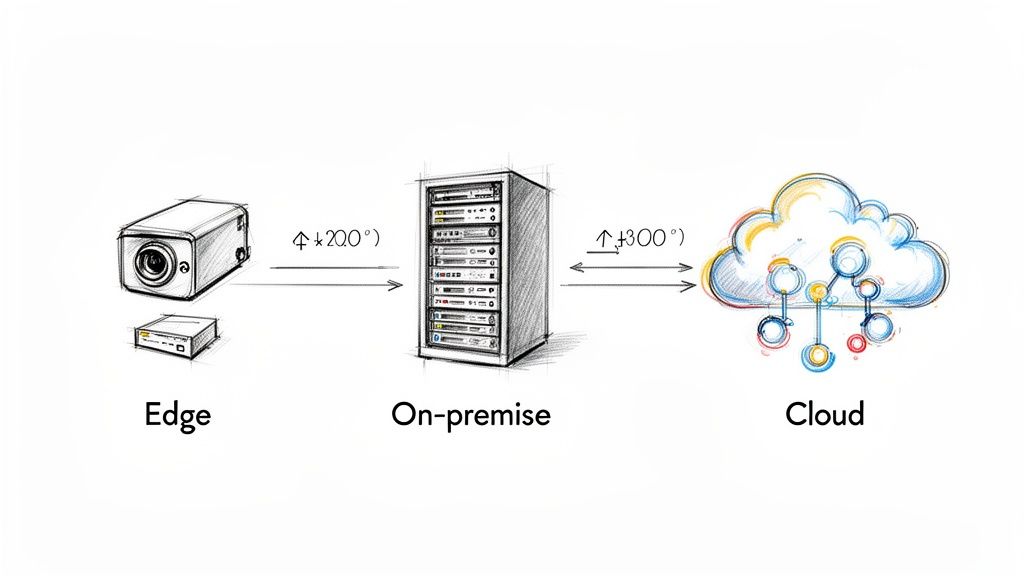
Three patterns dominate:
Edge computing for latency and confidentiality
Edge runs inference near the camera; only essential signals leave the site—ideal for low latency and keeping raw video local. See our edge AI overview for industrial settings.
On-premise for full control
On-premise centralises compute in your data centre.
You retain full control of infrastructure, data, and security—no third-party processing dependency.
Strength for strict policies; consider capex and internal operations.
Cloud for elasticity
Cloud moves streams to managed infrastructure for scalable compute—great for non-latency-critical workloads. Watch bandwidth and compliance guardrails. ARCY integrates with APIs and webhooks regardless of pattern.
Measuring return on investment
ROI needs concrete KPIs, not slogans. Global computer vision demand is growing; manufacturing in France leads with inspection and safety gains.
From benefits to operational KPIs
Replace vague “improve safety” goals with measurable targets—e.g. +50% intrusion detection effectiveness or −80% false alerts.
- Safety & compliance: Non-compliance detection rate, mean time to resolve, false alarms per day.
- Quality: Defect rates, finished-goods non-conformance, scrap avoided.
- Productivity: Operator time saved, fewer unplanned stops, logistics flow gains.
A solid business case links an operational problem to financial impact—AI as process optimisation, risk reduction, and margin improvement.
ROI dashboard
Compare before/after with a simple dashboard.
| Domain | KPI | Before AI | After AI (typical target) |
|---|---|---|---|
| Perimeter safety | False alerts per night | 15–20 | < 2 |
| Quality control | Undetected defect rate | 5% | < 1% |
| PPE compliance | Helmet non-wear rate | 12% (spot audits) | 2% (continuous) |
| Operations | Time to clear an alert | 5 minutes | 30 seconds |
See our market insights for deeper context.
FAQ: computer vision in industry
Will AI replace our security teams?
No. We position computer vision as a copilot. Operators receive qualified alerts instead of passive screen-watching, with anonymisation focused on events—not identities.
AI becomes an intelligent filter, freeing teams for triage and response.
Do we need to replace all cameras?
Rarely. We connect to standard RTSP streams on professional cameras already deployed and audit streams before recommending hardware changes—always aiming to maximise existing assets.
How do you manage false alerts?
This is critical: if a system generates too much noise, teams stop acting on alerts.
We use two complementary levers—explore each below:
Bespoke calibration
During the pilot we tune algorithms to your site: moving shadows, weather swings, and scene-specific noise.
Perfect zero-error systems are unrealistic; the target is trustworthy alert rates operators will act on.
Deploy visual AI on your sites with ARCY. We help turn video streams into concrete, auditable, scalable outcomes—explore our solutions and request a tailored demo.